
Subscribe to get access
Read more of this content when you subscribe today.
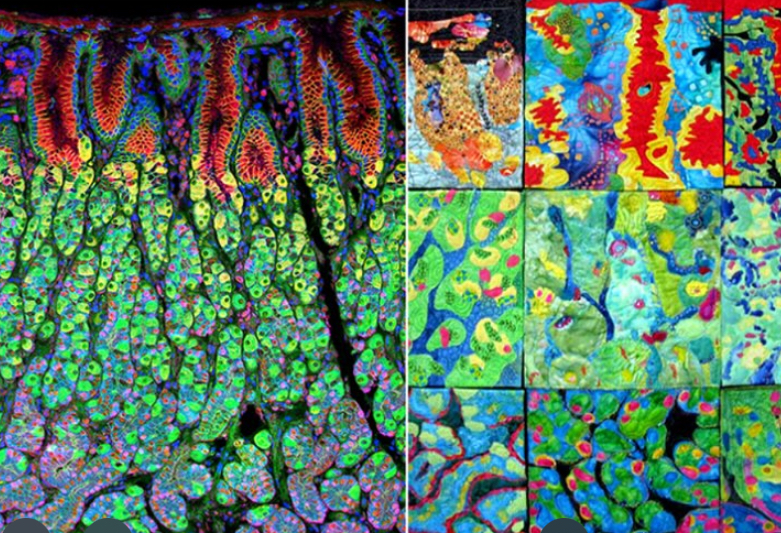
ART UNDER THE MICROSCOPE. CELL PRESS
HOW THE HUMAN CELL REACT WHEN THE PEOPLE DOING ART PAINTING?
When a person engages in art painting, several processes occur at the cellular level in the brain and body, promoting both mental and physical well-being. Here are the main reactions of human cells during painting:
1. **Neurotransmitter Release**
– **Dopamine**: is released in the brain.
– **Serotonin**: Painting can be relaxing and meditative, which stimulates the release of serotonin
– **Endorphins**: Engaging in enjoyable and relaxing activities like painting can trigger the release of endorphins
2. **Brain Cell Activation**
– **Hemispheric Communication**: Painting involves both the right hemisphere of the brain (responsible for creativity and imagination) and the left hemisphere (responsible for logic and fine motor skills).
3. **Stress Reduction and Immune System Boost**
– **Cortisol Reduction**: The relaxation and immersion that painting provides can lower cortisol levels, the hormone responsible for stress.
– **Immune Cells**: Lower stress levels
4. **Increased Blood Flow and Oxygenation**
– **Blood Cells**: Painting, especially when done for extended periods, enhances focus and attention, improving blood circulation to the brain..
5. **Muscle and Nerve Response**
– **Fine Motor Skills**: As the person manipulates the brush, pen, or other tools, **muscle cells** in the hand and arm are activated.
– **Sensory Nerve Stimulation**: The sensory experience of seeing colors
6. **Memory and Emotional Processing**
– **Hippocampus Activation**: stimulate the hippocampus, the brain region associated with memory formation.
– **Emotional Cells**: Cells in the limbic system, particularly the **amygdala**, process emotional responses.
In summary, when a person paints, it activates a wide range of cellular and neural processes that promote mental clarity, stress relief, improved mood, and enhanced cognitive function.

THE BENEFITS OF DOING ART FROM 2 Y OLD
Do you know that when
2-year-old kids paint, they do create new brain connections — and it’s a powerful part of early development.
🧠Here’s How Painting Builds Brain Connections:
1. Fine Motor Skill Development
• Holding a brush, finger painting, or using crayons helps build hand-eye coordination and muscle control.
• These activities strengthen the motor cortex and support skills needed later for writing and self-care.
2. Sensory Integration
• Painting stimulates multiple senses (sight, touch, sometimes smell), helping the brain process and integrate sensory input, which is essential for focus, balance, and learning.
3. Creative Thinking & Problem-Solving
• When a child decides what to paint or chooses colors, their brain engages in decision-making and creative problem-solving, forming connections in the prefrontal cortex.
4. Language & Communication
• Talking about their painting (even with limited words) helps build language pathways and boosts vocabulary and self-expression.
5. Emotional Development
• Painting can help children express feelings nonverbally, building emotional intelligence and helping with self-regulation.
#creativity #artbenefits #kidsdevelopment #scientistproven #artoflife #kidsdevelopment #brainhealth #brainnews
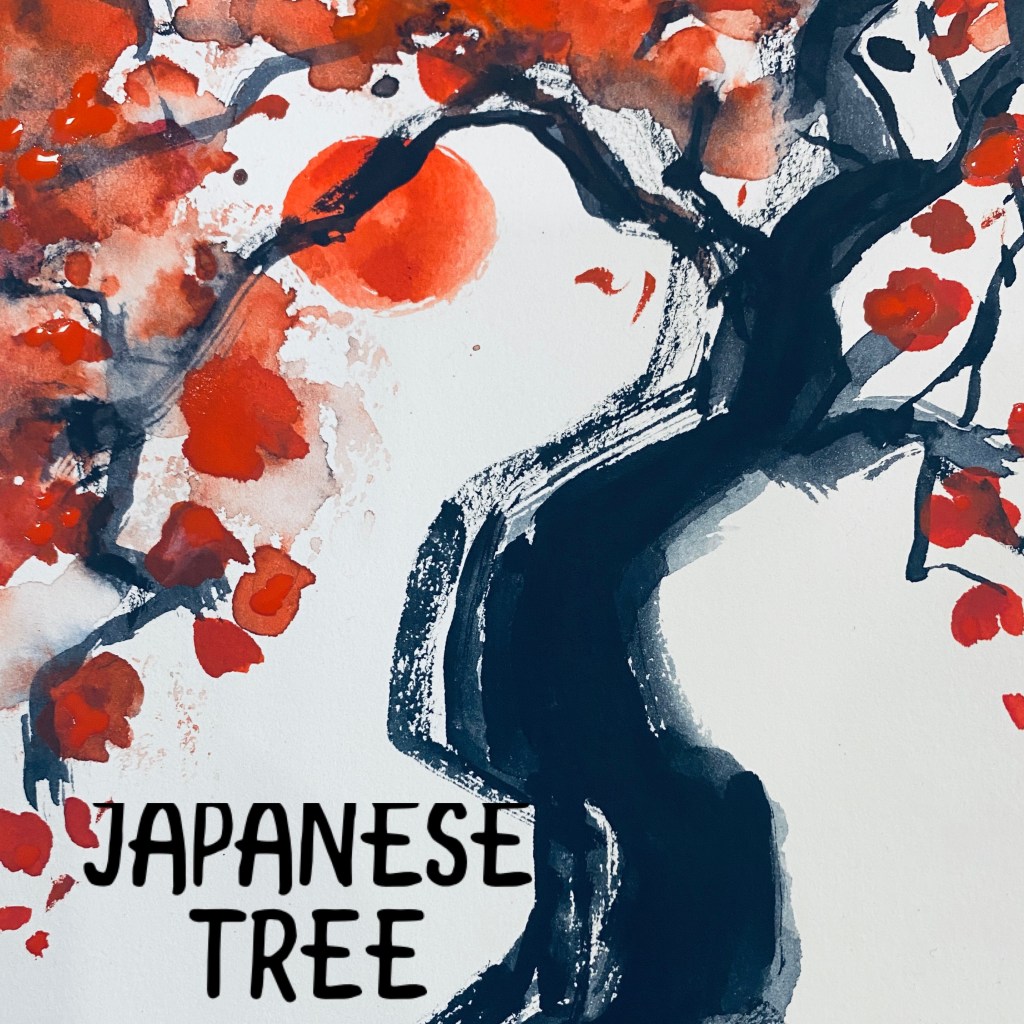
JAPANESE ART | TREE AND SUN SYMBOLISM
Painting the Japanese Tree and the Sun
In traditional Nihonga painting or sumi-e ink wash, the motif of a tree silhouetted against the rising or setting sun evokes a moment suspended in time. This imagery taps into several key aesthetic principles of Japanese art:
• Wabi-sabi – the appreciation of beauty in imperfection and transience
• Ma (間) – the space or pause that gives balance and meaning to a composition
• Yūgen (幽玄) – a subtle, profound grace beyond what can be seen
When a Japanese tree is placed against the backdrop of the sun, the result is often both meditative and powerful. The twist of a pine branch, or the falling petals of a cherry tree, gain new meaning when bathed in the soft amber of sunrise or the burning red of dusk.
Symbolism in the Scene
• Cherry Blossoms + Sun
Represent the fleeting nature of life (sakura blooms only for a week or two), intensified by the setting or rising sun, which marks the passing of time. This combination often evokes nostalgia, reflection, and the quiet beauty of moments that do not last.
• Pine Trees + Sun
Pines symbolize endurance and longevity. When shown in the morning light, they represent hope and spiritual grounding. In snowy scenes with a red sun above, they convey stoic perseverance in adversity—a common theme in Japanese scrolls and seasonal prints.
🖼️ A Living Canvas in Japanese Home
Modern Japanese-style interior design often features artworks with these themes: a lone pine on a hill under a crimson sun, or delicate cherry branches stretching toward the dawn. These pieces are not just decorative—they are visual poems, inviting stillness and thought.
Many contemporary artists now reinterpret these traditional scenes in digital art, watercolor, or mixed media, combining ancient symbolism with modern techniques. The result is timeless: the tree and the sun continue their quiet dialogue, across canvas and across centuries.
To paint—or even simply to admire—a Japanese tree and the sun is to engage with something deeper than visual beauty. It’s to step into a long-standing conversation between nature, time, and spirit.
Whether in the minimalist curve of a pine trunk or the pink scatter of cherry blossoms beneath a red-orange sky, these artworks remind us: life is precious, passing, and profoundly beautiful in its stillest moments.
In Japanese culture, trees and the sun hold significant symbolic meaning, often intertwined. Trees like the pine and maple are revered for their association with longevity, good fortune, and resilience. The sun, especially as represented by the rising sun, is a powerful symbol of Japan, embodying life, prosperity, and the imperial lineage. The concept of “Komorebi” further illustrates the beauty of the sun’s light filtering through trees, highlighting the appreciation for nature’s ephemeral moments.
Here’s a more detailed look:
Trees:
- Pine (Matsu):
The pine tree is a symbol of longevity, good fortune, and steadfastness. It’s often linked to virtue and even immortality. - Maple (Momiji):
Japanese maple trees are a recognizable motif, symbolizing peace, longevity, and prosperity. - Other Trees:
Willow, bamboo, and plum trees also appear in Japanese art and symbolism, often representing different virtues and aspects of nature.
Sun:
- Rising Sun: The rising sun, a central element in the Japanese flag, represents Japan itself, as well as life, prosperity, and the sun goddess Amaterasu, the mythological ancestor of the imperial family.
- Spiritual Significance: The sun is a symbol of material and spiritual prosperity and renewal.
- Komorebi: This specific term describes the sunlight filtering through trees, emphasizing the beauty of light and shadow in nature.
Intertwined Symbolism:
- Nature’s Beauty:
The concept of Komorebi highlights how trees and the sun, when combined, create a beautiful and fleeting moment in nature. - Spiritual Connection:
Shinto, Japan’s indigenous religion, emphasizes the connection between nature and the divine, with trees often being seen as sacred spaces or dwellings for spirits (kami). - Cultural Values:
The symbolism of trees and the sun reflects Japanese cultural values, such as appreciating nature, finding beauty in the ephemeral, and recognizing the cyclical nature of life.


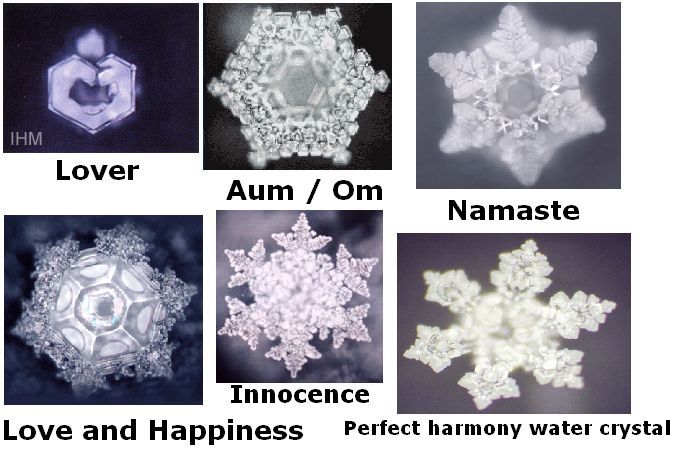
- THE MEMORY OF THE WATER WHEN
- PAÎTING | DR MASARU
- Dr. Masaru Emoto’s “the memory of water” relates to painting because he posited that water’s molecular structure changes based on external stimuli like words and music, forming beautiful crystals with positive intent and distorted patterns with negative intent. This idea inspires artists to use water in their work to reflect these concepts, exploring its role as a life-force and a medium that can hold memories and emotions, mirroring human consciousness and our connection to the natural world.
- Emoto’s Work and Its Connection to Art
- Water’s “Memory”:
Emoto’s central idea was that water possesses a “memory” and that human consciousness—through thoughts, words, or music—can influence its physical structure. - Ice Crystal Photography:
He used microscopic photography to capture the patterns of ice crystals formed after exposing water to different stimuli, noting that positive messages resulted in harmonious, symmetrical shapes, while negative ones created fragmented, disfigured patterns. - A Blueprint for Reality:
Emoto viewed water as a “blueprint for our reality” and believed that its ability to reflect emotions and consciousness made it a profound subject for artistic exploration. - How Artists Engage with This Idea
- Symbolism and Energy:
Artists are drawn to this concept because it connects water to the human condition and allows them to explore themes of consciousness, emotion, and spiritual purity. - Water as a Medium:
Some artists directly incorporate water into their paintings, attempting to capture its essence or using it to convey ideas about its inherent qualities and sensitivities to its environment. - Visualizing Memory:
Painters might aim to visually represent the intricate structures of water crystals that Emoto claimed to observe, offering a tangible way to experience the “memory” or energy that water is said to hold. - Viewer Interaction:
Some artworks are designed to be dynamic, reflecting the viewer, thus allowing them to participate in the creation and conceptually bring their own energy to the piece, aligning with Emoto’s notion of water’s responsiveness to consciousness.
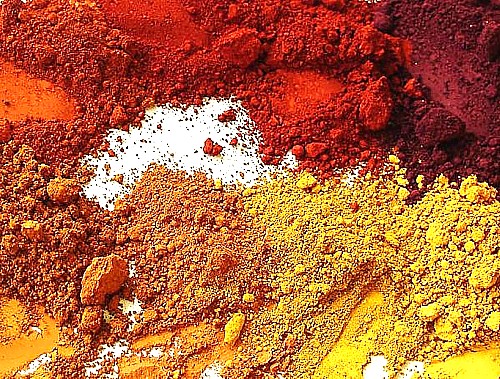

- THE ORIGIN OF THE PAINT COLORS PIGMENTS
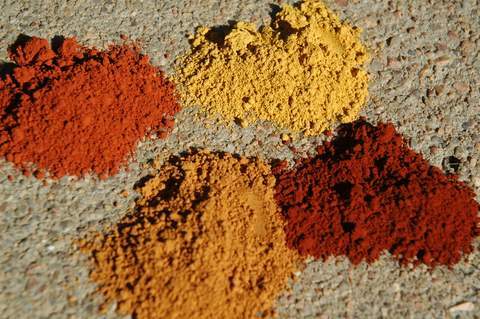
The origins of paint pigments date back over 100,000 years, with early humans using natural earth pigments like ochres (red, yellow) and charcoal for black, mixing them with binders such as animal fat or plant sap to apply to cave walls. Key developments include the invention of Egyptian bluearound 3250 BC, the first synthetic pigment, and the use of precious mineral pigments like lapis lazuli for blue, which traveled through the spice trade routes. Over time, pigments evolved from natural sources to synthetic ones, with later developments in the Renaissance and beyond seeing artists create new colors and artists like Yves Klein invented Klein’s Blue and acrylics in the 1940s, drastically changing the palette available to artists.
Prehistoric Origins (40,000+ Years Ago)
- Materials:
Early artists used materials like crushed ochre (iron oxide) and charcoal (carbon black) for red, yellow, and black pigments. - Binders:
These powdery pigments were mixed with binders such as animal fats, plant sap, or water to create a paint. - Application:
Paints were applied with fingers, brushes made of animal hair, or by blowing through hollow bones.
Ancient Civilizations (Egypt, China, Rome)
- Synthetic Pigments:
Ancient Egyptians developed the first synthetic pigment, Egyptian blue, by heating limestone, sand, and copper-containing minerals. - Mineral Pigments:
Both Egyptians and ancient Chinese cultures used mineral paints derived from sources like malachiteand azurite. - Trade:
The spice trade facilitated the movement of pigments like lapis lazuli (a source of precious ultramarine blue) across Asia and Europe.
The Renaissance and Beyond - New Earth Colors:
Italian artists created new earthy colors by “burning” (roasting) raw pigments like umber and sienna. - Plant-Based Pigments:
The development of oil painting techniques during the Renaissance allowed for astonishing color and depth. - Modern Developments:
In the 20th century, acrylic paint was invented in the 1940s, offering a cheap, water-based alternative to oil paints. Artists like Yves Klein also created their own unique blues.
Key Pigments and Their Origins
- Ochres:
Earth pigments, including red and yellow ochre, were some of the first pigments used. - Charcoal:
Also known as carbon black, it was made from burning organic materials and used as a black pigment. - Lapis Lazuli:
A rare blue stone from Afghanistan, it was more valuable than gold during the Renaissance and was used for ultramarine blue pigment. - Indian Yellow:
This distinctive pigment was once created from the urine of cows fed only mango leaves. - Viridian Green:
Developed in the mid-19th century, this synthetic green pigment became a favorite for Impressionist and Post-Impressionist painters.
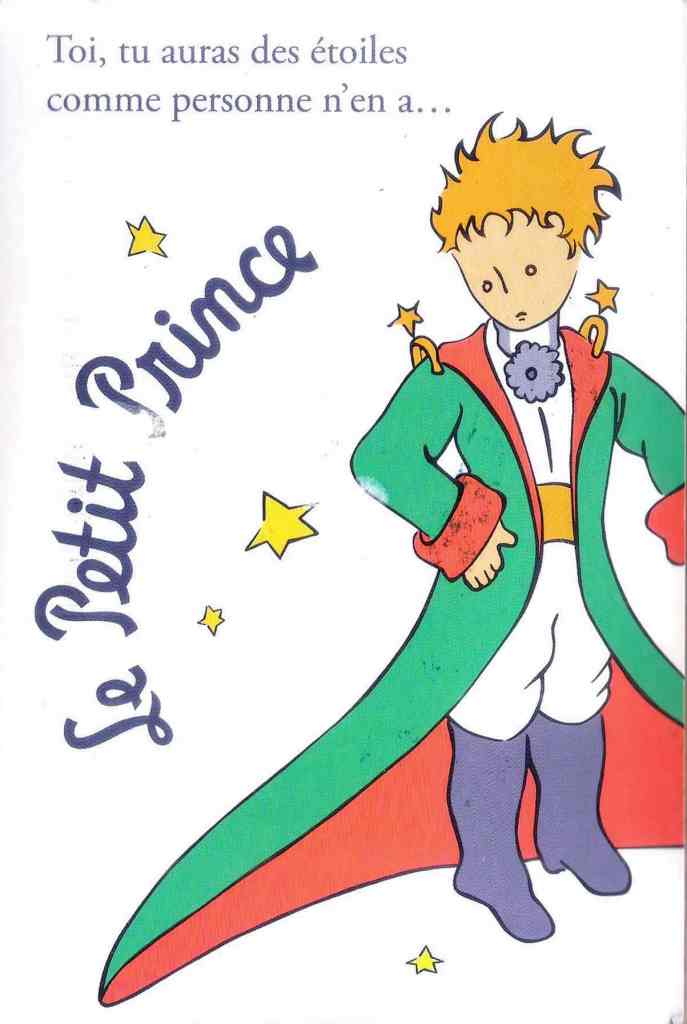
- THE LITTLE PRINCE | Interesting facts about the illustrations
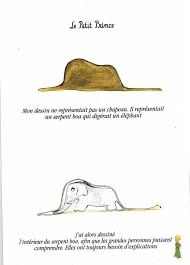
The original illustrations for The Little Prince were created by author Antoine de Saint-Exupéry himself, using a simple, expressive watercolor style that captured the book’s poetic and childlike perspective. These drawings, including the famous boa constrictor and elephant, serve to highlight the contrast between child-like innocence and the narrow-mindedness of adults. The illustrations’ emotional impact and symbolic meaning make them integral to the story, reflecting Saint-Exupéry’s own return to childhood wonder.
Key Facts About the Illustrations
Author-Created:
Saint-Exupéry, a pilot and artist, illustrated the book himself, creating over 40 watercolor images for the original publication.
Symbolic Drawings:
The illustrations are more than just pictures; they are essential to the story’s meaning. For example, the drawing of a boa constrictor swallowing an elephant is a test for adults, who often mistake it for a hat, revealing their lack of imagination.
Return to Childhood:
The act of drawing for the book represents Saint-Exupéry’s attempt to reconnect with his own childhood perspective, which was often rejected by adults.
Watercolor Style:
The illustrations are characterized by a simple, expressive watercolor style that reflects the book’s emotional and whimsical tone.
Integral to the Narrative:
By including drawings alongside text, Saint-Exupéry challenged the convention that stories should be purely written. The illustrations enrich the narrative and help the reader understand concepts that are difficult to express through words alone.
Lost and Found Sketches:
Some of the original preparatory sketches for the book were discovered years after Saint-Exupéry’s death, with some eventually being shared with institutions like The Morgan Library and Museum.
- INTERESTING FACTS ABOUT THE STAR SIRIUS
Sirius is the brightest star in Earth’s night sky, located in the Canis Major constellation, and is a binary star system known as the Dog Star. It’s a close neighbor at 8.6 light-years away and gets its brightness from its proximity and high luminosity, not just because it is a single bright star. The system consists of Sirius A, a hot blue-white star, and the faint, Earth-sized white dwarf Sirius B, the first of its kind to be discovered. Its presence in the ancient sky marked the “dog days of summer” and was important in ancient Egyptian and Greek cultures.
Star System & Composition
- Binary System:
Sirius is actually two stars orbiting each other: Sirius A and the fainter Sirius B. - Sirius A:
This is the main star, a hot, main-sequence star (a star that generates energy by converting hydrogen into helium) that gives off a brilliant blue-white light. - Sirius B:
The companion, Sirius B, is a white dwarf, a small, dense “dead star” that is about the size of Earth but with the mass of our Sun. It was the first white dwarf star ever discovered.
Brightness and Location
- Brightest Star:
Sirius is the most prominent and brightest star in the night sky, almost twice as bright as the second-brightest star, Canopus. - Closest Neighbor:
It’s one of our closest stellar neighbors, located just 8.6 light-years from Earth. - Constellation:
Sirius resides in the constellation Canis Major, which means “Greater Dog”.
Name & Cultural Significance
- Origin of Name:
The name “Sirius” comes from the Greek word “Seirios,” meaning “glowing” or “scorching”. - Dog Days:
The star is known as the “Dog Star” because of its association with Canis Major, and its rise with the Sun coincided with the hottest part of the summer, leading to the term “dog days of summer”.
- FLORENCE BIENALE INTERESTING FACTS
- An interesting fact about the Florence Biennale is that it was founded in 1997 with the goal of creating an independent platform for both emerging and established artists, free from commercial market pressures. In its first edition, it attracted 317 artists from 20 countries, and since then, it has grown to feature thousands of artists from over 100 countries. Each edition also features the “Lorenzo il Magnifico” International Award for Art.
- Independent platform: The Biennale was established by brothers Pasquale and Piero Celona to create a space for artists independent of commercial interests and institutional constraints.
- International scope: The initial edition in 1997 saw a strong international response, and the event has since grown to include artists from more than 100 countries.
- Award recognition: An important part of the event is the “Lorenzo il Magnifico” Awards, which are given to the best exhibiting artists for their works and are named after the Renaissance patron Lorenzo de’ Medici.
- Historical connection: By holding a major contemporary art exhibition in Florence, the Biennale creates a striking contrast between the city’s Renaissance heritage and modern artistic expression.
In addition - What is the history of the Biennale?
- The origin. The Venice Biennale was born by a resolution by the City Council on 19th April 1893, which proposed the founding of a “biennial national artistic exhibition” to take place in the following year, to celebrate the silver anniversary of King Umberto and Margherita of Savoy.
- What does Biennale mean?
- In the art context, biennial (or biennale, as it is sometimes styled) has come to mean a large international exhibition held every two years.
- What was the first Biennale?
- the Venice Biennale
- So in 1895 the first ‘International Art Exhibition’ of the Venice Biennaletook place. It was extremely popular and over 200,000 visitors came to Venice, eager to see the latest artworks on display
INTERNATIONAL ART PRIZE ARTIST IN THE ART HISTORY | DIANA RAYCHEVA | ARRLESSONS CUSTOMART
International Prize “Artist in the Art History” I am very proud to be honored with the award the International Prize “Artist in the Art History” at Florence.Prize worth my artistic merit.Through my creations, powerfully and authentically express my artistic vision.The awards ceremony for the International Prize Artist in the Art History project, curated by Francesco…

LA ART SHOW > DIANA RAYCHEVA BOOTH N 911
The extraordinary art of Diana Raycheva-ArtLessons Custom Art@freelanceartistd @freelanceartistrwill be a meaningful contribution to the Los Angeles art scene from 7th till 11th January 2026. Thanks for the special invitation from Artifact Projects @artifactprojectsThe exhibition at the LA Art Show @laartshowhttps://www.laartshow.com/, isthe oldest and the largest art fair on the West Coast. It will take place in January 7-11,…
LA ART SHOW 7>11 Jan 2026
DIANA RAYCHEVA | ART LESSONS CUSTOM ART The extraordinary art of Diana Raycheva-ArtLessons Custom Art@freelanceartistd @freelanceartistrwill be a meaningful contribution to the Los Angeles art scene from 7th till 11th January 2026.Thanks for the special invitation from Artifact Projects @artifactprojectsThe exhibition at the LA Art Show @laartshowhttps://www.laartshow.com/, isthe oldest and the largest art fair on the West Coast.It…
Knighthood recognition‘ Lady Diana Raycheva ´
‘’Knighthood decree ‘’LADY DIANA RAYCHEVA’’bestowed by Duke Dr. Thomas André Louis Maes, Count of Brasschaat, Consul, Duke of Gerani. Today marks a defining moment in my life—one that has become a symbol of an entire journey. On December 26, 2025, I was honored with the appointment as Knight Commander of the Sacred Imperial Constantinian Angelic…


DIPLOMA DI PARTECIPAZIONE
DIANA RAYCHEVA | ARTLESSONS CUSTOMART BIENNALE INTERNAZIONALE D’ARTE CONTEMPORANEA E DESIGN DIPLOMA DI PARTECIPAZIONE LA BIENNALE DI FIRENZE 18-26/10/2025 THE SUBLIME ESSENCE OF LIGHT AND DARKNESSConcepts of Dualism and Unity in Contemporary Art and Design Thanks to | Grazie a @celonajacopo@florencebiennale @freelanceartistr@freelanceartistr As a participant I am glad to see you there. Within the framework…
FLORENCE BIENNALE XV
DIANA RAYCHEVA | ARTLESSONS CUSTOMART LA BIENNALE DI FIRENZE 18-26/10/2025 THE SUBLIME ESSENCE OF LIGHT AND DARKNESSConcepts of Dualism and Unity in Contemporary Art and Design It’s a privilege for me to be part of the Florence Bienale catalogue together with Tim Burton and all the international artists @celonajacopo@florencebiennale@timburton@freelanceartistr As a participant I am glad…
XV FLORENCE BIENNALE
It’s a privilege for me to be part of the Florence Bienale together with Tim Burton and all the international artists @celonajacopo@florencebiennale@timburton@freelanceartistr LA BIENNALE DI FIRENZE 18-26/10/2025 THE SUBLIME ESSENCE OF LIGHT AND DARKNESSConcepts of Dualism and Unity in Contemporary Art and Design As a participant I am glad to see you there. Thanks to…
 ArtlessonsCustomart